The introduction of AI Mode in search engines marks a change in how people are using search engines, requiring digital teams to re-evaluate organic customer acquisition strategies.
Marketing departments focused on traditional SEO must proactively adapt to these observable shifts in behaviour to maintain organic competitiveness and relevance.
What AI search means for commercial SEO
The integration of AI into search alters how online commercial intent is captured. Adapting content strategies is important for marketing teams relying on organic traffic.
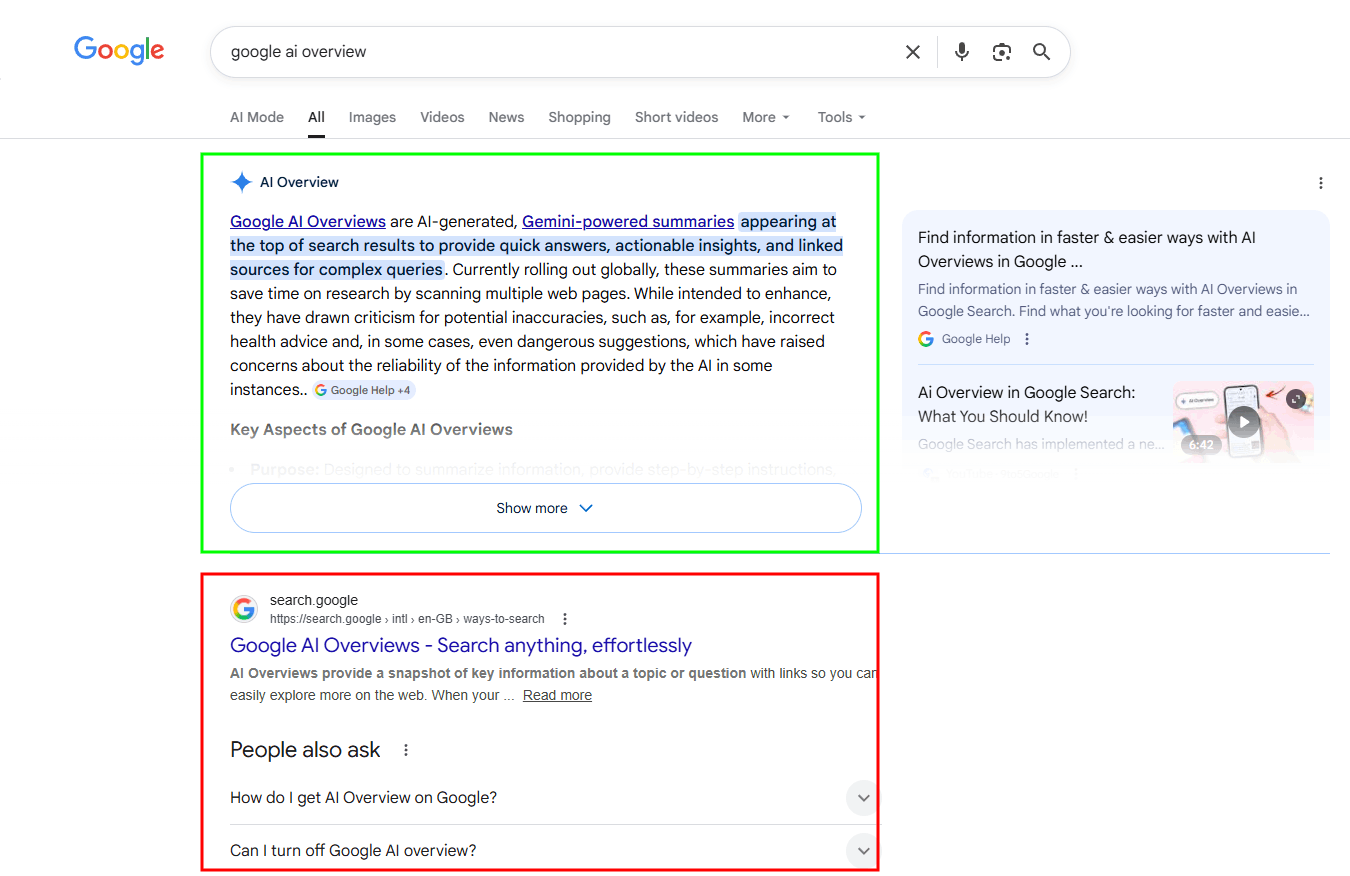
Traditional search engines display lists of options. Conversational platforms, AI Mode, and AI Overviews provide direct, synthesised answers directly within the results page. The customer journey is compressed into the search engine itself, reducing the immediate necessity for a user to click through to your website.
Your optimised website could be bypassed for certain queries if your audience adopts AI for research, unless your content serves as the foundational data for the AI’s answer. The competitive organic landscape is shifting toward gaining visibility within these generated responses. Marketing teams responding swiftly to this evolving format will better position themselves for continued search visibility.
How conversational AI is shifting search behaviour
Conversational AI search differs vastly from traditional organic search, influencing content planning and user expectations.
Search has historically been driven by short, fragmented keywords (e.g., “B2B marketing agency”). Intent is now expanding toward highly specific, conversational prompts (e.g., “What are the best B2B marketing agencies for manufacturing companies in the UK?”). Users increasingly treat search engines like digital assistants, meaning search queries are becoming longer, more complex, and inherently conversational.
Inferring conversational intent in Google Search Console
The core challenge for search marketers is quickly assessing how material this shift is for your specific market and audience.
It is important to clarify that we cannot currently see or tag “AI Mode queries” directly in Google Search Console (GSC). While Google has mentioned the possibility of tracking AI-driven queries in Google Search Console (GSC), it is still unclear if or when this will happen.
Until then, we can infer conversational intent via word length. GSC already captures many of these complex, conversational searches, but they are often buried deep within your performance data, hidden beneath high-volume, traditional short-tail keywords. Informing your content strategy and finding meaningful gaps requires isolating these longer queries to understand exactly what your audience is asking.
The Regex trick: Finding 6+ word long-tail queries
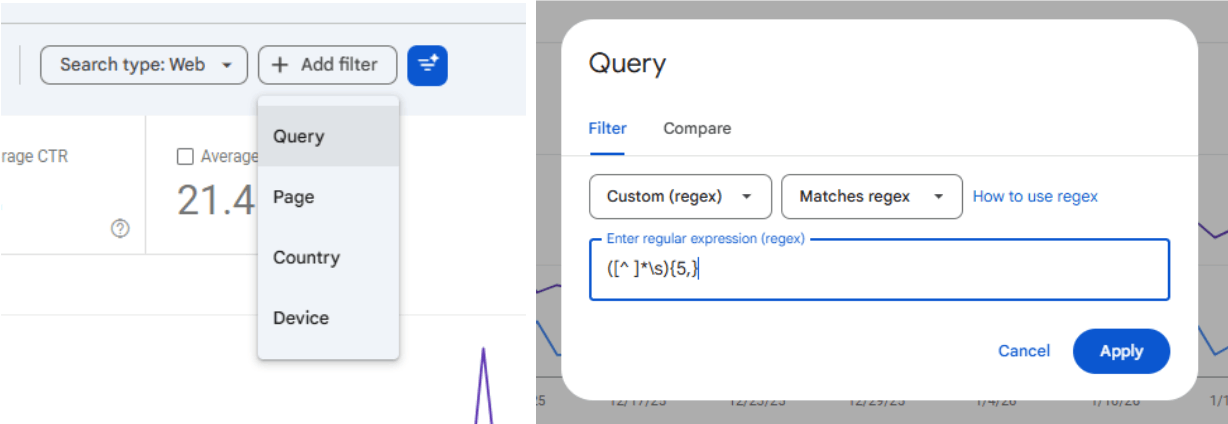
Because conversational queries mimic natural human language, filtering your search data by word count is an effective way to uncover them. Using a simple Regular Expression (Regex) filter in Google Search Console instantly isolates queries containing six or more words.
The Regex formula for 6+ words:
([^ ]*\s){5,}
Apply this by navigating to your GSC Performance report. Click + New > Query > Custom (Regex) > Matches Regex, and paste the code above.
This formula searches your data for five or more spaces, isolating queries with six or more words.
It is important to explicitly state that a six-word threshold is a heuristic, not a definitive marker of AI queries. This does not mean every six-word query originates from AI behaviour, nor does it mean shorter queries are irrelevant. It is a directional filter to surface conversational patterns at scale.
Uncovering these hyper-specific queries provides a data-backed roadmap for your content creation team.
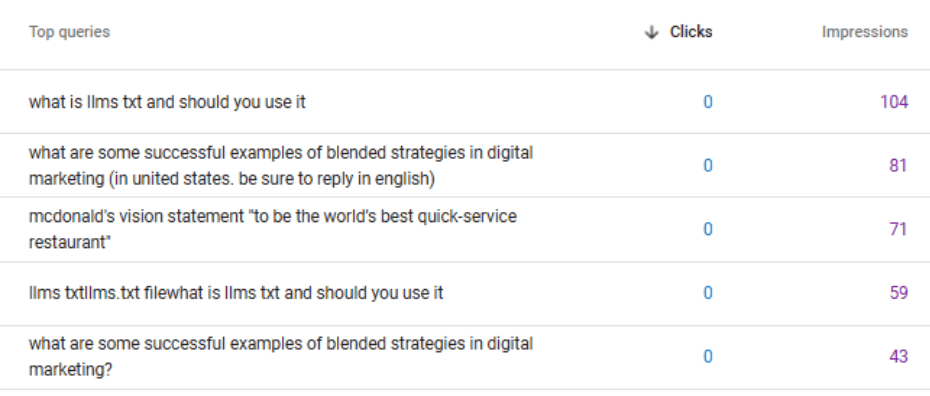
Here are some long-tail, conversational searches from recent posts on the WilsonCooke blog:
Generate the number of words regex filter
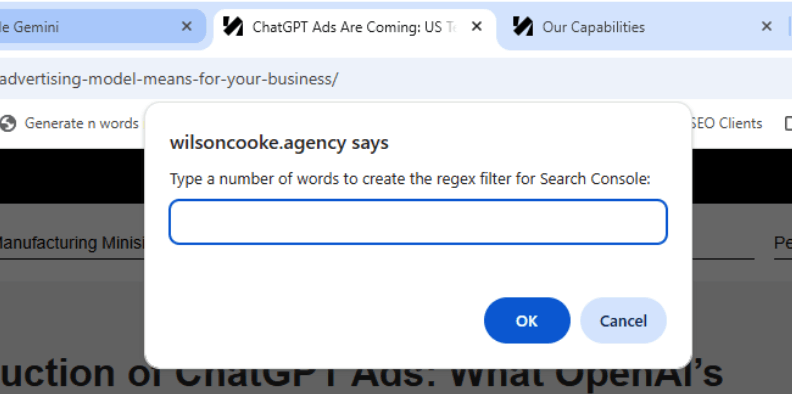
If you need to do this regularly, or want to use a different number of words, use the button below to generate your regex:
Num words regex filter
*you can drag this link to your bookmarks bar to use this whenever needed.
Turning conversational data into a content strategy
Marketing teams must evaluate these conversational queries pragmatically, focusing on user intent rather than sheer search volume.
Determine first whether your target audience actually uses these long-form queries to research your products or services. Generating impressions for highly specific, six, seven or eight word questions identifies a clear, actionable content gap. Consider next whether your current landing pages truly satisfy this conversational format. Robust content directly answers a user’s question, whereas older SEO content often merely dances around a core keyword.
Capturing visibility in these zero-click searches and AI Overviews requires structured, authoritative answers that ensure your content converts. Providing accurate answers to specific, high-intent questions increases the likelihood of your content being cited by AI models in their generated responses.
Preparing your content strategy for AI search
Preparing for AI search requires building new tactical capabilities and integrating them with your current content calendar. Traditional SEO skills, such as keyword density tracking, are rapidly losing relevance. Your content team must focus on authoritative writing that answers customer questions directly, incorporating FAQ schema, clear headings, and emerging standards like llms.txt to ensure it is structured seamlessly for AI systems to parse.
Optimising for AI Mode must enhance, not replace, your existing search channels. Users and their intent differ across platforms. Your measurement and analytics tracking must adapt to monitor how these long-tail queries drive qualified traffic and assist conversions. Success requires a unified approach to content creation, technical SEO, and performance analytics.
A pragmatic approach to search evolution
Navigating this landscape effectively starts with an assessment of your audience’s conversational search behaviour and its impact on your acquisition funnel.
It is easy to look at a dashboard and sensationalise that AI search has arrived in GSC. At WilsonCooke, we take a more pragmatic, data-based approach. We know that long-tail filters don’t equal exact AI traffic, but by looking at what this data infers based on search length and conversational terms, we gain an additional layer of understanding and context that many miss.
Marketing teams unsure about their readiness for this channel, or needing help evaluating its relevance within their own Search Console data, can rely on WilsonCooke. WilsonCooke offers expert guidance tailored to technical SEO and content strategy. We help you make informed decisions based on your market data and campaign objectives.
Next Steps for Evaluating AI SEO
AI-driven search creates significant new opportunities for organic growth. Navigating this landscape effectively starts with an assessment of your audience’s conversational search behaviour and its impact on your acquisition funnel. Ensure your content strategy directly aligns with conversational AI outputs.
For a detailed audit of your organic readiness and content gaps, contact WilsonCooke. Our search experts will help optimise your organic strategy in this evolving channel.